
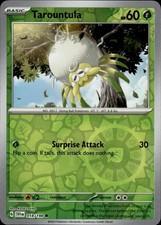


Tarountula 018/198 Reverse Holo – A Closer Look at This Scarlet & Violet Common
If you enjoy building themed decks, collecting early cards from new generations, or simply love the Paldean spider Pokémon, the Tarountula 018/198 Reverse Holo (Scarlet & Violet) in near mint condition is a fun and affordable card to add to your binder.
This listing appears to offer a Reverse Holo common Tarountula from the Scarlet & Violet base set, with an ungraded but described near mint condition. Below is a quick reference before we dive into how this card fits into the Pokémon anime, collecting, and gameplay.
Tarountula 018/198 Card Information
| Card Name | Tarountula |
|---|---|
| Set | Scarlet & Violet (Base Set) |
| Card Number | 018/198 |
| Rarity | Common |
| Finish | Reverse Holo |
| Condition (per listing) | Near Mint, Ungraded |
| Approximate Price | $1.99 USD (at time of listing) |
| Evolution Line | Tarountula → Spidops |
The price and availability may change over time, but as of the listing, this reverse foil Tarountula is positioned as an accessible entry for collectors of the Paldea era and players looking for low-cost Grass-type basics.
Tarountula in the Pokémon World and Anime
Tarountula is one of the early-route Bug-type Pokémon introduced in the Pokémon Scarlet & Violet video games set in the Paldea region. In the games, you encounter Tarountula very early, making it one of the first partners many players catch, much like Caterpie, Wurmple, or Sewaddle in past generations. This gives Tarountula a kind of “nostalgic from day one” feeling for fans of Generation 9.
In the broader Pokémon media, including anime-style adaptations and promotional material, Tarountula is portrayed as a small, ball-like spider that hangs from threads of silk. Its silk has been described in lore as exceptionally strong, hinting at why it later evolves into the more tactical and stealthy Spidops. While specific, ongoing anime episodes featuring Tarountula can change over time, it tends to be used in stories that highlight early-game adventures, training new Pokémon, and life in Paldea’s countryside.
Because Tarountula is an approachable, non-threatening spider design, it appeals both to younger fans and to collectors who like to follow a Pokémon’s whole journey from its first appearance in the games and anime through its TCG cards. Having a Reverse Holo Tarountula 018/198 from the very first Scarlet & Violet set helps mark that starting point in cardboard form.
For anime fans who primarily collect cards of Pokémon they recognize from the screen, this card serves as a neat bridge between the Paldea adventures and their physical collection. Even a common can become a sentimental favorite when it matches a Pokémon you’ve seen in episodes, trailers, or special animations.
Artwork and Reverse Holo Pattern
While this specific listing’s images focus on the card rather than a zoomed-in art preview, the Scarlet & Violet base set Tarountula cards are known for featuring a clean, modern art style that highlights Paldea’s environment. The Reverse Holo version uses the new Scarlet & Violet-era reverse foil pattern, which typically adds a reflective sheen across the card background, leaving the art box itself non-foil.
This means the Pokémon artwork stands out cleanly while the rest of the card catches light and color. The updated rarity symbols and borders from Scarlet & Violet give the card a different feel compared to Sword & Shield-era commons. If you’re building a binder page of Paldean Bug-types or early-route Pokémon, the Reverse Holo foiling offers some extra sparkle without becoming an expensive chase card.
Reverse Holos are also great for players who like to visually separate key cards in their deck. A Reverse Holo Tarountula will stand out when you quickly fan through your cards during a match, and the gloss can make the card feel a bit more special than a regular non-holo common.
Collectors who enjoy consistent binder aesthetics often pick up Reverse Holo versions of their favorite commons to make the page look more premium. At a listed price around $1.99, this Tarountula Reverse Holo offers that upgraded look at a low entry cost compared to full arts, ex cards, or secret rares from the same era.
Condition and Why Near Mint Matters
The listing describes this Tarountula 018/198 Reverse Holo as NM (Near Mint) and Ungraded. In typical Pokémon TCG usage, near mint implies a card that has only very minor wear, if any: perhaps negligible micro-scratching on the holo or very light edge signs that you might only notice under close inspection. The exact condition can vary by seller, but “near mint” generally indicates a card suitable for competitive play and binder display without obvious flaws.
Because the card is ungraded, it has not been evaluated by third-party grading services like PSA, CGC, or Beckett. That’s normal for inexpensive commons and reverse holos. Grading is usually reserved for chase cards or higher-value pieces. For someone looking to play the card in a deck or just fill a collection page, ungraded near mint is typically ideal: it keeps the cost low while still delivering a visually clean copy.
For buyers who are building a set or chasing near mint Pokémon cards for long-term storage, checking a reputable store is important. This listing originates from an eBay store that specializes in Pokémon cards, and browsing that seller’s Pokémon TCG singles can help you find matching-condition cards from the same set so your binder pages look consistent.
Over time, even basic commons in high grade can become harder to find, especially when they are from the first set of a generation like Scarlet & Violet. Picking up near mint copies early helps future-proof your collection if you later decide to grade a full set or sell as a near mint binder collection.
Collecting Value: Where Does Tarountula 018/198 Fit In?
From a pure financial perspective, a Reverse Holo common like Tarountula 018/198 is considered an entry-level collectible rather than a high-end investment card. Its value mainly lies in its role within set completion, fandom, and aesthetic appeal, rather than speculation or rarity.
That said, collectors often care about more than just prices. Here’s how this card fits into several collecting goals:
1. Scarlet & Violet Base Set Completion
If you’re working on a master set of Scarlet & Violet, you’ll want both the regular common and, in many cases, the Reverse Holo version. Reverse Holo slots are one-per-pack and cover a wide range of rarities, so completing the full reverse foil section can be surprisingly time-consuming. Buying singles like this Tarountula Reverse Holo helps fill those gaps faster than random pack opening.
2. Paldea & Bug-Type Themed Collections
Some collectors build pages or binders around specific themes: Bug-type teams, Paldea region teams, or evolution lines. Tarountula and its evolution, Spidops, fit nicely into a Paldea-themed binder that includes starters, regional birds, and other early-route companions. A Reverse Holo common can act as the “highlight” card for that section when you’re not chasing full arts or ex versions.
3. Early-Generation Nostalgia
Every new generation’s first set tends to be remembered fondly. Having a representation of early-game Pokémon like Tarountula preserves that sense of discovering Paldea for the first time. In the long run, complete or near-complete Scarlet & Violet base set binders could gain sentimental value among fans who started in Gen 9.
Because the current listing is affordably priced, it’s an easy add-on if you’re already picking up other collectible Pokémon cards from the same seller and want to round out shipping with a few low-cost Reverse Holos.
Gameplay and Deck Strategy: How Playable Is Tarountula?
As a common Basic Pokémon from Scarlet & Violet, Tarountula’s primary role in the Pokémon TCG is to serve as an evolving basic into Spidops (and any future cards that reference this line). Although the exact attacks and stats of this specific print aren’t detailed in the listing, commons of this type usually have straightforward Grass-type attacks that cost 1–2 Energy and offer modest damage or utility.
In competitive play, most Tarountula cards are not standalone powerhouses; instead, they’re stepping stones into their evolutions. Grass- or control-focused decks that want to leverage Spidops cards (for example, strategies that involve trapping the opponent in the Active Spot or manipulating retreat costs) may naturally include multiple copies of Tarountula.
Even if Tarountula itself is not a central threat, there are a few reasons a Reverse Holo copy like this can be desirable to players:
- Visual distinction – One Reverse Holo copy among several non-holo Tarountulas can help you quickly identify your preferred starting basic or remind you which copy has a particular marking or sleeve.
- Personalization – Some players simply like to bling out their decks where possible. A Reverse Holo common is a low-cost way to make a Grass deck look more polished without investing in expensive cards.
- Casual and theme decks – If you play casual games built around Paldea or Bug-types, a foil Tarountula fits the theme and appeals to newer players who love shiny cards.
Because the card is affordable and in near mint condition, it’s also safe to shuffle and play with regularly without feeling like you’re risking an especially high-value piece. For newer players building their first 60-card decks, this kind of card can make the experience feel more special while remaining budget-friendly.
Who Should Consider Buying This Tarountula Reverse Holo?
Not every card is meant for every kind of collector or player. This Tarountula 018/198 Reverse Holo particularly suits a few groups:
1. Scarlet & Violet Set Builders
If you’re assembling a thorough binder of Scarlet & Violet, you’ll eventually want every Reverse Holo common. Tarountula 018/198 is one of those must-have puzzle pieces. Purchasing it directly can be more efficient than repeatedly opening booster packs hoping to pull this specific card.
2. Paldea and Spider Fans
Tarountula’s unique round body and web-hanging pose make it a stand-out design among Bug-types. Fans of spiders or of the Paldea region might want a dedicated page of Tarountula and Spidops. A Reverse Holo near the front of that page sets the tone for the collection and highlights Tarountula as the starting point of its line.
3. Budget-Conscious Players
For players building basic Grass or Paldea-themed decks, Reverse Holo commons like this add flair without inflating deck costs. If you prefer to put your budget toward key ex or rare cards, picking up low-cost Reverse Holos strikes a good balance between style and efficiency.
Because it’s a low-risk purchase at around $1.99, this card can also be an easy add-on when you’re already shopping for higher-value singles from a store like Pokeferh’s collectible Pokémon cards.
How to Store and Protect Your Tarountula 018/198
Even though this is a common, keeping your Reverse Holo Tarountula in top shape helps preserve both its appearance and any future value it might hold within a complete set. Holo surfaces can be more susceptible to scratching, so a few basic steps go a long way:
- Use penny sleeves – As soon as you receive the card, consider placing it in a standard soft sleeve to protect the foil from fingerprints and dust.
- Toploaders or binders – For long-term storage, either keep the sleeved card in a rigid toploader or put it in a zip-up binder with side-loading pages to minimize movement.
- Avoid direct sunlight – Prolonged exposure to sunlight can fade colors over time. Store your cards in a cool, dry location away from windows.
- Keep sets together – When building a Scarlet & Violet binder, grouping cards by number helps you quickly see what Reverse Holos are still missing and prevents duplicates from getting lost.
A cheap Reverse Holo today could be the final piece of a cherished complete set tomorrow, so it’s worth taking basic precautions to keep it looking near mint.
Buying Reverse Holo Commons vs. Opening Packs
Many players and collectors eventually face a choice: keep opening booster packs to chase specific Reverse Holo commons, or buy singles directly. For cards like Tarountula 018/198 Reverse Holo, singles usually make more sense if you already know what you want.
Packs are great for the thrill of opening and for building a trade binder, but they’re random. If you’re only missing a handful of cards, spending a couple of dollars on each missing Reverse Holo is often cheaper than buying multiple boosters.
Buying singles also lets you target specific conditions. When a listing specifies “Near Mint” and provides card photos, you can better predict what you’ll receive. That’s especially helpful if you’re picky about whitening, centering, or holo scratching.
If you’d like to combine this Tarountula Reverse Holo with other Scarlet & Violet singles or Paldea favorites, browsing a focused store like Pokeferh’s Pokémon TCG singles can help you build a cart that perfectly matches your collecting or deck-building goals.
FAQ: Tarountula 018/198 Reverse Holo (Scarlet & Violet)
Is Tarountula 018/198 Reverse Holo rare?
Tarountula 018/198 is a common card with a Reverse Holo treatment. While it’s not rare in the same sense as ultra rares or secret rares, Reverse Holos are less common than standard commons because each booster pack usually contains only one reverse slot. Its collectability is tied more to set completion and fandom than to scarcity.
Is this card good for competitive Pokémon TCG play?
Tarountula is primarily an evolving Basic Pokémon, meant to lead into Spidops. On its own, it likely has modest attacks suited for early game or casual play. Its main competitive value comes from enabling any strong Spidops cards in your deck, rather than dominating games by itself.
What does “Near Mint” ungraded mean for this listing?
In this context, “Near Mint” indicates that the card appears to have minimal wear, with clean surfaces and edges suitable for play and display. “Ungraded” means it has not been submitted to a grading company. The seller’s photos and description give the best indication of the actual condition you’ll receive.
Why would I buy a Reverse Holo common instead of a regular common?
Reverse Holo commons like this Tarountula add visual appeal to decks and binders. They are popular among collectors who want a more premium look for their favorite Pokémon or who are assembling complete Reverse Holo sets. At relatively low prices, they offer an easy way to upgrade the look of your collection.
Does this card appear in the Pokémon anime?
Tarountula itself is a Paldea-region Bug-type that appears in Generation 9 media and promotional materials. Specific anime episodes and roles can change over time, but it typically shows up as an early-route Pokémon encountered by trainers exploring Paldea, much like Caterpie or Wurmple in earlier generations.
Is this a good gift for a new Pokémon fan?
Yes. Reverse Holo cards tend to excite newer fans because they shimmer and look more special than standard commons. Pairing this Tarountula Reverse Holo with a few other Paldea cards can make a thoughtful, low-cost gift for someone just starting to enjoy the games, anime, or TCG.
Can this card increase in value over time?
Reverse Holo commons are generally not investment-focused cards. However, they can gain modest value as part of complete sets or if demand grows among Scarlet & Violet collectors. Their primary value is sentimental and aesthetic, especially for fans of Tarountula or Paldea.
Where can I find more cards like this?
If you’re looking to expand your collection with more Scarlet & Violet singles, Reverse Holos, or other near mint Pokémon cards, you can explore dedicated eBay stores such as Pokeferh, which regularly lists a variety of Pokémon TCG cards across multiple sets and rarities.
